How a battery pack is rated: voltage, Ah, Wh and C-rate
, 1 min read
Four numbers describe any pack: its voltage, its amp-hours, its watt-hours and its C-rate. Learn what each means and how they set range and power.
The article below is in English. The summary and Listen are in your language.
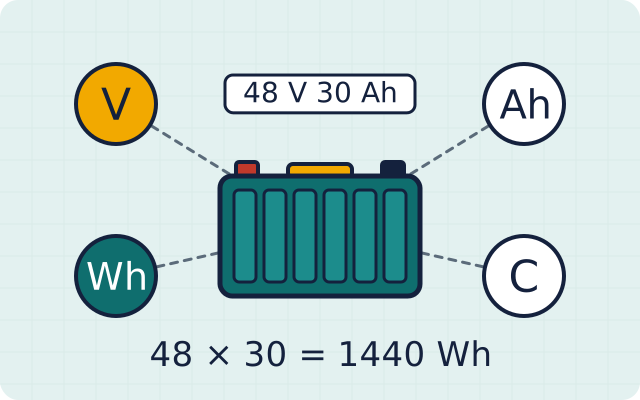
Every battery spec sheet throws four numbers at you. Once you know what they mean, you can size any pack.
Voltage sets the 'push'
Cells in series add voltage. A '48 V' scooter pack is usually 13 cells in series (13S), because 13 x 3.6 V nominal is about 48 V. More series cells means higher voltage, which lets the motor make more power without huge currents.
Amp-hours and watt-hours
Amp-hours (Ah) measure how much charge the pack holds. Cells in parallel add Ah. Watt-hours (Wh) are the real energy: Wh = volts x Ah. A 48 V, 30 Ah pack holds about 1,440 Wh, or 1.44 kWh. Range depends on Wh, not on Ah alone.
A 13S4P pack of 21700 cells rated 5 Ah each is 13 x 3.6 V and 4 x 5 Ah = 46.8 V, 20 Ah, roughly 0.94 kWh. Usable energy is a little less because the BMS keeps a buffer at the top and bottom.
C-rate is speed of charge or discharge
A C-rate of 1C means charging or discharging the full capacity in one hour. 0.5C takes two hours; 2C takes thirty minutes. High C-rates make heat, so fast charging needs cooling and a chemistry that can take it.
Size a pack by starting from the range you need, multiplying by the vehicle's Wh per km, then adding a margin for ageing and buffer.