CAN bus in an EV: how the parts talk to each other
, 1 min read
The BMS, controller, dashboard and charger all need to agree. CAN bus is the shared language that lets them.
The article below is in English. The summary and Listen are in your language.
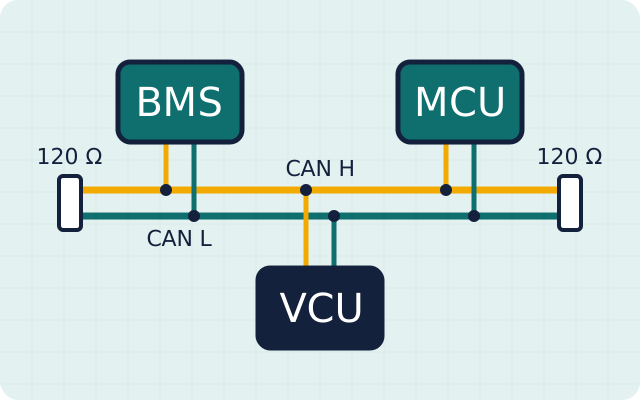
An EV is a team of electronic parts, and they must talk. Most use a CAN bus, a two-wire network that every part listens and speaks on.
One shared wire pair
CAN uses two wires, CAN-High and CAN-Low, running to every module. Any module can send a message; all the others can hear it. Messages carry an ID that says what they are about, such as 'pack voltage' or 'motor temperature'.
Why it is used
It needs only two wires for the whole vehicle, it is robust against electrical noise, and it handles priorities so important messages get through first. If one wire is damaged or a module is noisy, faults often show up as the dashboard losing data or warning lights.
CAN is a multi-master, message-based bus with built-in error checking and arbitration by message ID (lower ID wins). Typical EV buses run at 250 or 500 kbit/s and are terminated with 120-ohm resistors at each end.
You can see messages move in the CAN bus experiment in the EV Lab.