Inside a BMS: the parts and what each does
, 1 min read
The battery management system is a small board with a big job. Here are its main parts and the role of each.
The article below is in English. The summary and Listen are in your language.
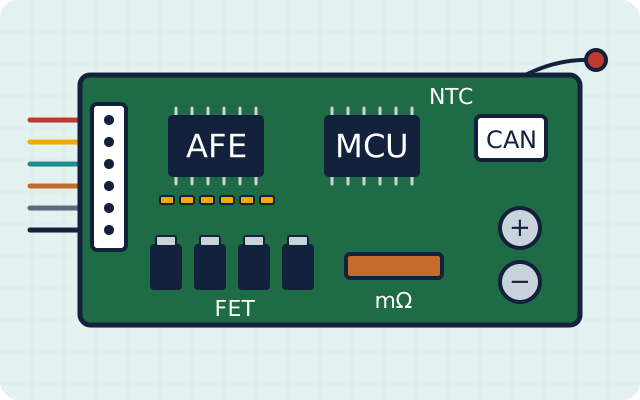
A BMS looks like a plain circuit board, but it is the guard of the whole pack. Each part has a clear job.
Sensing and the controller
Voltage taps read every series group of cells; thermistors read temperature at a few points; a shunt or hall sensor reads current. A small microcontroller takes all of this and decides what the pack is allowed to do.
Switching and balancing
Power MOSFETs (or a contactor on big packs) connect or cut the pack from the outside world. Balancing resistors bleed the fullest cells during charge so the cells stay equal.
The protections a BMS enforces are over- and under-voltage per cell, over-current in charge and discharge, short circuit, and over- and under-temperature. Many BMS also report SOC and SOH over a serial or CAN link.
A healthy BMS is invisible: it only makes itself known when it cuts power to keep the pack safe.