Passive vs active cell balancing
, 1 min read
Both keep cells equal, but they work in opposite ways. Here is when each is worth the cost.
The article below is in English. The summary and Listen are in your language.
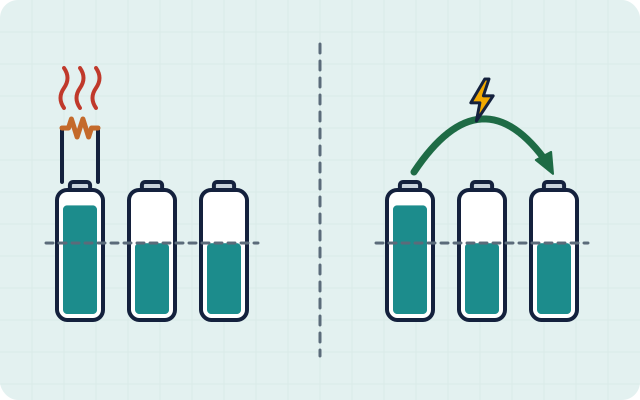
Balancing keeps every cell in a pack at the same level. There are two ways to do it.
Passive balancing
The BMS switches a resistor across any cell running ahead and burns off the extra as heat until the others catch up. It is cheap, simple and used in most scooters and e-rickshaws. The downsides are that it is slow and wastes a little energy.
Active balancing
Instead of burning energy, active balancing moves charge from fuller cells to emptier ones using small converters. It is faster, wastes less, and recovers more usable capacity from a drifted pack. It costs more and is found in premium packs and larger vehicles.
Passive balance currents are small (tens to a few hundred mA), so a badly drifted pack can need several charge cycles to settle. Active balancing can shift larger currents and helps most when cells differ a lot.
For most two- and three-wheelers, good passive balancing plus well-matched cells is enough.