Series and parallel: how cells become a battery pack
, 2 min read
A 48 V scooter pack is written as 13S4P. Here is what that means, and how to work out voltage, capacity and energy from the cells inside.
The article below is in English. The summary and Listen are in your language.
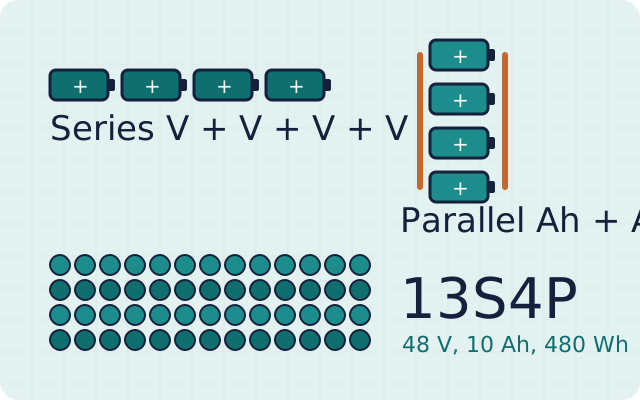
A battery pack is a group of small cells joined in two ways at once. Learning the two ways lets you read any pack label and check whether a replacement pack will fit the vehicle.
Series adds voltage
When cells are joined end to end, positive to negative, their voltages add up. Thirteen lithium cells of about 3.7 V each in series give about 48 V. This is written 13S.
Parallel adds capacity
When cells are joined side by side, positive to positive and negative to negative, the voltage stays the same but the capacity adds up. Four cells of 2.5 Ah in parallel give 10 Ah. This is written 4P.
Put together: 13S4P
A 13S4P pack has 52 cells. Its voltage comes from the 13 in series and its capacity from the 4 in parallel, so it is about 48 V and 10 Ah.
Energy in watt-hours
Energy is voltage multiplied by capacity. 48 V multiplied by 10 Ah is about 480 Wh. If a scooter uses 30 Wh for each kilometre, this pack gives roughly 16 km, before allowing for a safety margin. Try your own numbers in the pack builder in the EV Lab.
More exactly, 13 × 3.7 V = 48.1 V nominal and 48.1 V × 10 Ah = 481 Wh. Usable energy is lower than the label because packs are not run from completely full to completely empty, and because capacity falls with cold, high current and age. LFP packs use about 3.2 V per cell, so a similar pack would be 15S or 16S.
Why every cell in a pack must match
Cells joined together should be the same type, capacity and age. A weak cell in a series string is pushed too low on every ride and too high on every charge, which is why the BMS and balancing matter so much.