State of charge vs state of health: what each tells you
, 1 min read
SOC is how full the battery is now; SOH is how much life it has left. Confusing the two leads to bad buying and bad maintenance decisions.
The article below is in English. The summary and Listen are in your language.
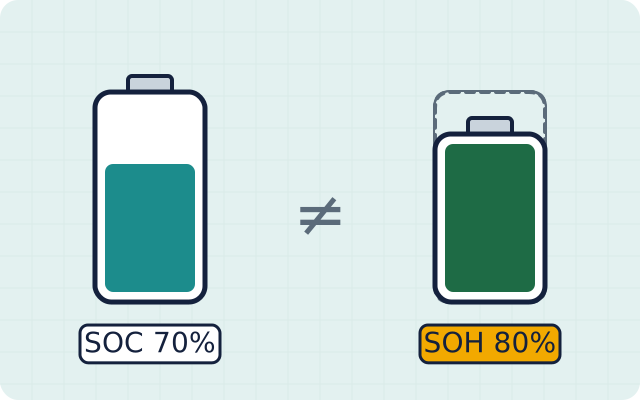
Two 'health' numbers describe a battery, and they answer very different questions.
State of charge (SOC): how full, right now
SOC is like a fuel gauge: 100% is full, 0% is empty. It changes every time you ride or charge. The BMS estimates it from cell voltage and by counting the current in and out over time.
State of health (SOH): how much life is left
SOH compares the pack today to when it was new. A pack at 80% SOH holds only 80% of its original energy, so a scooter that once did 100 km now does about 80 km on a full charge. SOH falls slowly over years and cycles and never comes back.
SOH is usually defined as present usable capacity divided by rated capacity. Internal resistance also rises with age, which hurts power and fast-charging more than it hurts range.
Why the difference matters
A used EV can show 100% SOC (fully charged) yet have poor SOH (a tired pack). When buying second-hand, never judge by the charge gauge. Ask for a capacity test or watch the real range on a full charge. For maintenance, low range on a healthy, well-charged pack usually points to SOH, not to the charger.